32 Weirdest Town Names in New Mexico (and How They Got Their Names)
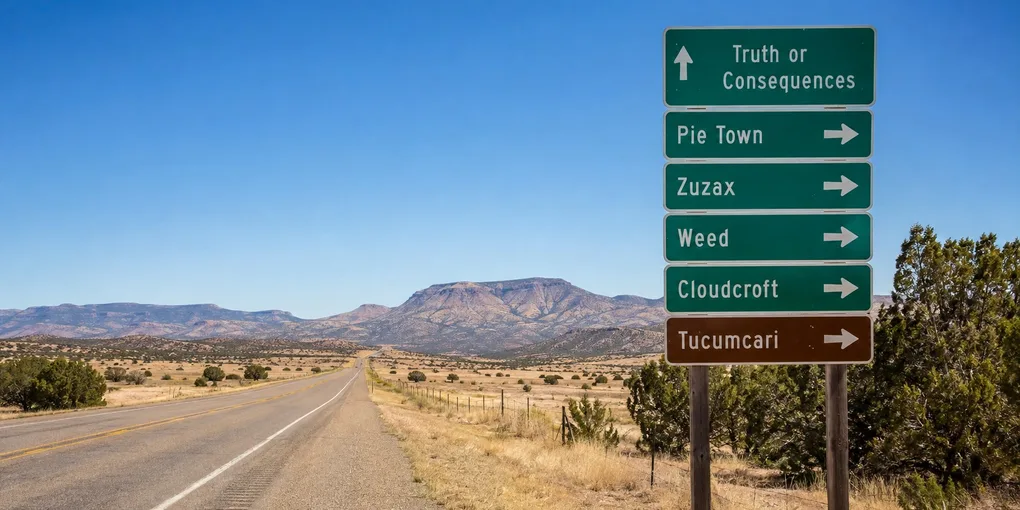
New Mexico has hundreds of communities with names drawn from Spanish, Indigenous languages, railroad history, mining camps, local geography, and occasionally someone’s imagination. Some of New Mexico’s weirdest town names include Truth or Consequences, Pie Town, Weed if you’re using the town name generically, Candy Kitchen, Rattlesnake, Zuzax, Elephant Butte Lake State Park, Radium Springs, and City of the Sun. Some have fascinating stories behind them, while others are memorable simply because they sound strange on a road sign.
Popular Unusual Names
Truth or Consequences
Probably New Mexico’s most famous unusual town name, Truth or Consequences was originally called Hot Springs. The town adopted its current name in 1950 after the popular radio game show Truth or Consequences announced that it would broadcast from the first community willing to rename itself after the program.
Pie Town
Pie Town was named after an early roadside merchant who became known for selling homemade pies to travelers crossing western New Mexico. The name is generally associated with Norman Smith, a miner and storekeeper who served pies to people traveling west during the 1920s.
Zuzax
Zuzax is a completely invented name. Entrepreneur Herman Ardans coined it for a Route 66 trading post he opened during the 1950s, reportedly choosing the name so it would appear near the end of alphabetical directories.
Carrizozo
The area around Carrizozo was once known as Carrizo Flats, after the Spanish word carrizo, meaning reeds or reed grass. According to local tradition, the additional “zo” was added to emphasize the abundance of carrizo growing there.
Albuquerque
Albuquerque was named for Francisco Fernández de la Cueva, the Duke of Alburquerque and viceroy of New Spain. The original Spanish spelling included a second “r,” which was gradually dropped. The name Alburquerque is generally traced to the Latin words albus and quercus, meaning “white oak.”
For many visitors, Albuquerque is the easiest place to start a New Mexico road trip because it combines easy logistics, a strong food scene, and nearby access to the Sandia Mountains.
Short Names and Names That Are Fun to Say
Jal
Jal is a small oil and ranching town in southeastern New Mexico with one of the shortest municipal names in the state.
The name came from the enormous JAL cattle brand used on cattle brought to the area by the Cowden family. Jal later became a natural-gas boomtown; one well drilled nearby in 1928 reportedly produced more than 90 million cubic feet of gas per day.
Texico
Located directly on the Texas state line, Texico combines the names Texas and New Mexico.
The border is quite literal: Texico ends at the state line and the town of Farwell, Texas begins on the other side. Early Texico was reportedly a rowdy railroad-era cowboy town known for its saloons and dance halls.
Tucumcari
Tucumcari is one of New Mexico’s most recognizable place names. Its exact history has inspired several competing explanations, although the city’s tourism office traces it to a Comanche word meaning roughly “to lie in wait.”
Before becoming Tucumcari, the new railroad settlement briefly had considerably less glamorous nicknames, including Ragtown and Six-Shooter’s Siding.
Bibo
Bibo is a tiny community west of Albuquerque named for the Bibo family, German Jewish merchants who became prominent traders in territorial New Mexico.
The family has one of the stranger stories in New Mexico history: Solomon Bibo married into Acoma Pueblo and was later elected governor of the Pueblo, popularly remembered as the “Jewish Indian chief.”
Towns Named After Animals
Rattlesnake
Rattlesnake is a tiny unincorporated community in northwestern New Mexico near Shiprock within the Navajo Nation.
The origin of the name is not especially well documented, but it appears to refer quite literally to the rattlesnakes found in the area. It may be one of the least reassuring town names to encounter on a road sign.
Raton
Ratón means “mouse” or “small rat” in Spanish. The city took its name from nearby Raton Pass and the Raton Range, although the original reason those landmarks were associated with rodents remains uncertain.
One local explanation claims early travelers encountered large numbers of field mice in the area. The town itself was briefly known as Willow Springs before becoming Raton in 1880.
Truchas
Truchas means “trout” in Spanish. The village took its name from the Rio de las Truchas, or “River of the Trout,” which provided water to the Spanish land-grant settlement established there in 1754.
The village sits around 8,000 feet in the Sangre de Cristo Mountains and remained so isolated that a paved road did not reach it until the early 1970s.
Elephant Butte
Elephant Butte was named for a volcanic butte whose profile was thought to resemble an elephant lying on its side. The nearby city, reservoir, dam, and state park eventually inherited the same name.
In a particularly fitting coincidence, campers near Elephant Butte Reservoir discovered the fossil of an elephant-like Stegomastodon in 2014—but the town’s name predates the discovery and comes entirely from the shape of the rock.
Coyote
Coyote is a small northern New Mexico community whose name sounds suitably Southwestern.
Despite the Wild West name, Coyote sits at roughly 7,200 feet in the mountains of Rio Arriba County and was settled in 1862.
Names from Native Languages
Nageezi
Nageezi is a Navajo community in northwestern New Mexico whose name, Naayízí, means “squash.”
According to the Nageezi Chapter, the community was named for an elderly woman, Asdzaan Naayizi, who discovered a patch of dark-green wild squash in the area during the early 1900s.
Brimhall Nizhoni
Brimhall Nizhoni combines the English surname Brimhall with nizhóní, a Navajo word meaning “beautiful.” The exact origin of the combined name is not well documented.
The community is also known as Coyote Canyon and lies within the Coyote Canyon Chapter of the Navajo Nation. Navajo Chief Manuelito settled in this area after returning from the Long Walk in 1868 and spent the remainder of his life there.
Ohkay Owingeh
Ohkay Owingeh is the traditional Tewa name of the Pueblo formerly known as San Juan Pueblo and means “Place of the Strong People.” The Pueblo officially restored the name Ohkay Owingeh in 2005.
The community also occupies an important place in New Mexico history: Spanish colonists established their first capital nearby in 1598, and Popé, the leader of the Pueblo Revolt of 1680, was from Ohkay Owingeh.
Chilili
Contrary to what the spelling might suggest, Chilili has nothing to do with chile. The name predates the modern Hispanic community and comes from the earlier Tiwa Pueblo of Chilili that once stood along the creek.
The name is commonly interpreted as referring to a weak or slowly flowing spring. The original Pueblo was abandoned during the colonial period, while the modern community dates to an 1841 Mexican land grant meaning the unusual name survived even after the original settlement disappeared.
Mining, Railroad, and Company Town Names
Tyrone
Tyrone was established as a copper-mining company town in southwestern New Mexico, but it was considerably more ambitious than the average mining camp.
Phelps Dodge hired prominent architect Bertram Goodhue to design the original town as an idealized Southwestern village, complete with a central plaza and Pueblo and Spanish Revival architecture. The mines closed after copper prices collapsed in 1921, and the original townsite was eventually destroyed as the modern Tyrone open-pit mine expanded.
Acme
Acme was named for the Acme Gypsum Cement Company, which built a mill northeast of Roswell in 1906 to manufacture plaster and gypsum blocks. At its height, the little company town had around 100 residents, a school, and its own post office.
Despite the name, it has no connection to the fictional ACME Corporation supplying Wile E. Coyote with malfunctioning contraptions. Today, Acme is essentially a ghost town, with only scattered remnants of the settlement remaining.
Brilliant
Brilliant was a coal-mining town founded in northeastern New Mexico’s Dillon Canyon in 1905. Its name was fitting: the local coal was considered some of the best coking coal in the region and was known for its “brilliant” shiny appearance.
Brilliant was once a surprisingly substantial community. By 1920 it had more than 600 residents, and its clubhouse offered pool tables, a library, dances, and movies twice a week. Today, almost nothing remains.
Brilliant No. 2
Brilliant No. 2 has an even stranger naming history. The coal town was originally called Swastika, a name adopted decades before the symbol became associated with Nazi Germany.
In 1940, the town was renamed Brilliant No. 2 to escape that association. After the mine closed in 1953, many of its houses were physically moved to Raton, where some reportedly remain in use today.
Thoreau
Thoreau was originally known as Mitchell and appears to have been renamed for American writer and philosopher Henry David Thoreau after the railroad established a station there.
There is one catch: locals generally pronounce the town “thuh-ROO,” rhyming with “through,” rather than pronouncing it like the author’s name.
Names That Sound Like Everyday Words
Candy Kitchen
Candy Kitchen is a small community near Ramah in western New Mexico.
According to local tradition, the name originated during Prohibition, when a rancher making moonshine needed a believable explanation for purchasing large amounts of sugar. His wife sold homemade fudge as a front, giving the area the name Candy Kitchen.
Weed
Weed is a tiny mountain community in the Sacramento Mountains, near Cloudcroft.
Despite what modern visitors might assume, it was not named for cannabis or unwanted vegetation. The community and its post office were named for W. H. Weed, a merchant associated with the mining town of White Oaks.
Organ
Organ is a former mining community east of Las Cruces that shares its name with the dramatic Organ Mountains behind it.
The most widely accepted explanation is surprisingly literal: early observers thought the mountains’ tall, narrow rock spires resembled the pipes of a giant organ. That explanation was already being recorded by explorers in the 1840s.
Counselor
Counselor is a Navajo community in northwestern New Mexico.
Rather than referring to a therapist, attorney, or government official, the community was named for Jim Counselor, a trader who opened an early trading post in the area.
Names that Sound Like They Belong in a Movie
Radium Springs
Radium Springs was named during the early 20th-century fascination with radioactive mineral water and its supposed health benefits.
The springs were previously known as Fort Selden Springs, but when a post office was established in 1926, tests found enough naturally occurring radium in the water to justify the much more exciting name Radium Springs. The area even had a resort where visitors came to soak in the mineral water.
Cloudcroft
Cloudcroft’s name comes from an old English expression meaning roughly “a clearing covered in clouds.” The name was reportedly chosen by railroad surveyors who reached the Sacramento Mountains and were struck by clouds hugging the ground at nearly 9,000 feet.
The name was fitting: Cloudcroft was founded as a mountain resort, with excursion trains carrying visitors up from the desert below to escape the heat.
Holy Ghost
Holy Ghost is a small mountain community and recreation area tucked into a steep canyon of the Sangre de Cristo Mountains.
The supernatural-sounding name was not invented as a tourist gimmick: the U.S. Forest Service translated the area’s existing Spanish name, Espíritu Santo, into English and applied “Holy Ghost” to the creek, campground, and summer-home area.
City of the Sun
City of the Sun sounds like either an ancient civilization or a futuristic metropolis. In reality, it is a tiny intentional community next to Columbus in southwestern New Mexico.
Founded in 1972, City of the Sun had just 33 residents in the 2020 Census, making the grandeur of its name considerably funnier.
Continental Divide
Continental Divide is an actual community along Interstate 40 near the geographic Continental Divide, making its name sound more like a label from a physical geography textbook than a town.
The name is unusually accurate: water on opposite sides of the area ultimately drains toward completely different river systems. Despite its location, Continental Divide even has its own post office and had 187 residents in the 2020 Census.
Little Walnut Village
Little Walnut Village sits immediately north of Silver City along Little Walnut Creek, with the Gila National Forest bordering it to the north and west.
Despite sounding like the setting of a children’s book, it isn’t quite as tiny as the name suggests: the community had 1,386 residents in 2020, considerably more than places on this list with much more imposing names.
New Mexico’s unusual place names reflect every chapter of the state’s history. Spanish colonization, Indigenous languages, mining camps, railroads, local landmarks, company towns, radio contests, and outright invention have all left their marks on the map. The result is a state where a road trip can take you from Cloudcroft to Pie Town, through Truth or Consequences, and eventually all the way to Albuquerque and Santa Fe.